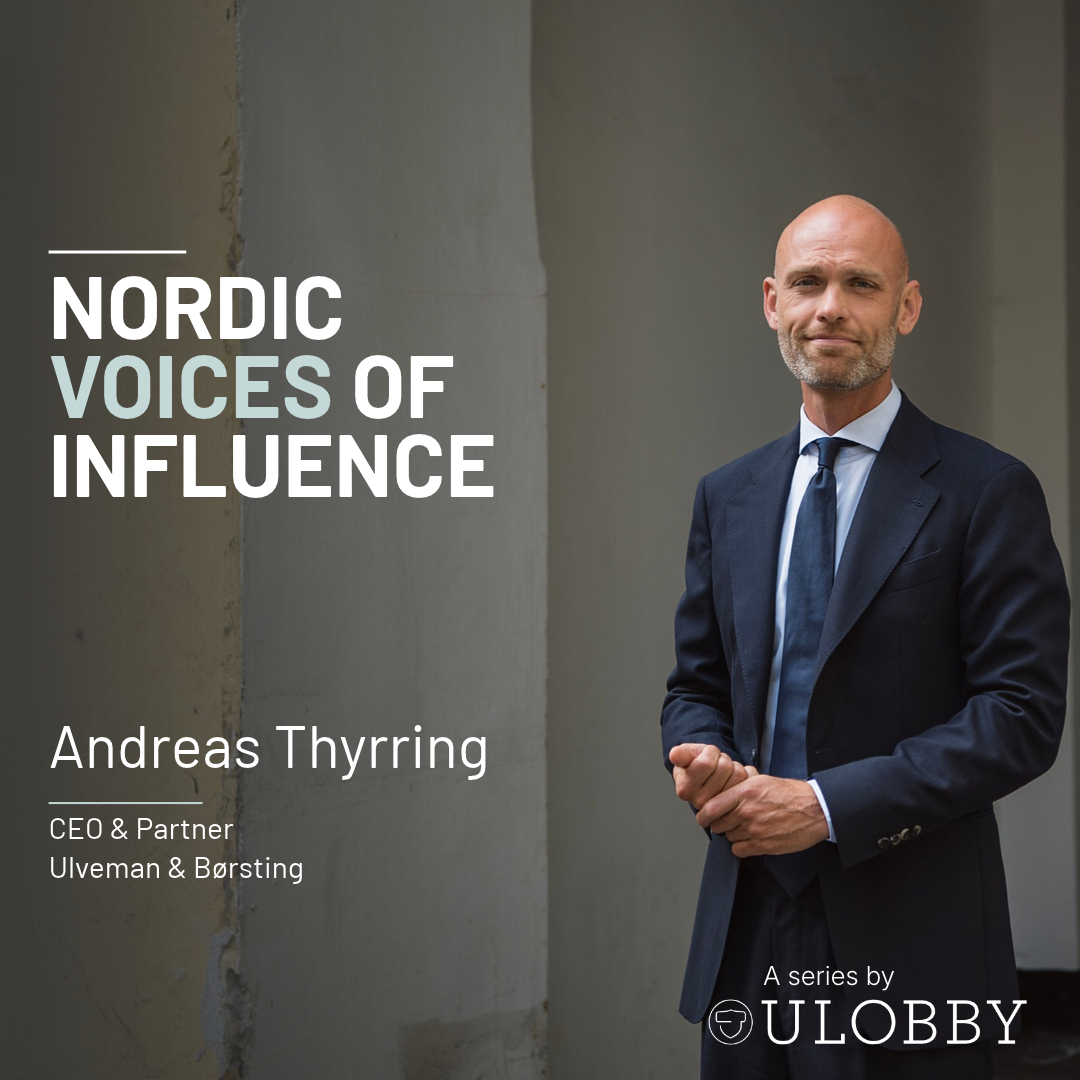
Andreas Thyrring - Nordic Voices of Influence
How has the Public Affairs discipline developed in the last five years, and how do you expect it to develop in the next five years?
The classic skills of the profession remain constant: the ability to become a trusted advisor to the client. An understanding of the client’s business and environment. The political instinct to translate the client’s issues and solutions for decision-makers. Maintaining and developing a network in the political environment.
What is new is mainly three things:
Working in an integrated way with public affairs and strategic communication across media platforms. It is about putting the client’s narrative out in the public sphere and being able to work with the issues in the media.
Executing and implementing strategies with the client. Value creation increasingly lies in executing and making things happen.
Creating value higher up the value chain for the client and solving business-critical and complex issues that require access, experience and human judgement.
What should a CEO expect to get from a strong PA function?
Delivering results that can be measured on the top or bottom line. If the public affairs function is not working on business-critical issues and commercial “must-wins”, it needs to move closer to the business and be relevant. That could be on specific issues, positioning in the market, or shaping the regulatory environment in which the company operates.
If PA is to be more data-driven and measurable, what should we actually be measuring?
Public affairs efforts must ultimately be measured on the top or bottom line. We risk “death by data” if we spend our time measuring all sorts of other things, and, after all, statistics are rather obliging. Ultimately, it is about creating value for the business.
How do you use AI in your Public Affairs work today - and what must AI never replace?
At Ulveman & Børsting, we have drawn up clear guidelines and an internal policy for the use of AI, including what AI should not be used for. AI can be a fantastic sparring partner and can be used to make many things more efficient. But there are no shortcuts to learning and maintaining the craft and putting in the hours. And the human and relational aspect will remain crucial in our industry. It is, and will remain, a people business.
Who has taught you most about political influence, and what did you learn from them?
That will be two top politicians called Lars. One has the surname Løkke Rasmussen. The other is called Lilleholt.
In 2018–2019, I worked closely with Lars Løkke Rasmussen, then Prime Minister and leader of Venstre (the Danish Liberal Party), and with the party leadership in preparing the campaigns for the 2019 European Parliament and general elections. With four seats, Venstre had its best European Parliament election ever and became Denmark’s largest party in the European Parliament. In the general election, Venstre won 23.4 per cent of the vote, the largest gain in seats of any party in the Danish Parliament, and became bigger than the rest of the blue (centre-right) parties combined. Løkke is an extraordinary political talent, tactician and opportunist. Løkke sees opportunities, is constantly thinking creatively and likes to keep decisions open for as long as possible. That makes being his adviser both challenging and a great learning experience.
As special adviser to the Minister for Energy, Utilities and Climate, Lars Christian Lilleholt (Venstre), from 2015 to 2018, I learned a great deal about political instinct and craft, political negotiations, working respectfully with Folketinget (the Danish parliament), and that you get far in politics by sharing the credit and the results. He taught me the value of being a good boss and creating a pleasant atmosphere around you in an often harsh and brutal political environment. It was from him that I learned the ability to create a sense of calm and slow things down when the stakes are highest.
What is the most important personal quality for a Public Affairs professional in 2026, and why?
Do the work and hold on to the classic skills of the profession. There are no shortcuts. AI cannot replace hard work and the honing of the human ability to become a trusted advisor to the client.
Share this article
The Ulobby platform provides all the tools needed for managing issues and stakeholders and for measuring and evaluating impact.
Get started